Why Organisations Need More Than Knowledge to Perform
Modern organisations have access to more knowledge than at any point in history. They collect data continuously, document procedures, commission research, run training programmes, and invest heavily in technologies designed to capture and share information. Yet despite all of this, many organisations continue to struggle with execution, adaptation, and sustained performance.
This presents a genuine puzzle. If knowledge matters as much as we claim, why do organisations with significant expertise still fail to achieve the outcomes they are working toward?
Part of the answer lies in a distinction that tends to get overlooked. Knowledge and capability are related, but they are not the same thing. Organisations often assume that acquiring knowledge automatically creates capability. In practice, the relationship is more complicated, and more interesting, than that.
Knowledge is a resource. Capability is the ability to draw on that resource effectively, repeatedly, and under real conditions. Acquiring one does not automatically produce the other, and understanding the difference between them helps explain why some organisations consistently translate ideas into results while others remain trapped in cycles of planning, discussion, and unrealised potential.
The Knowledge Trap
Many organisations operate under what might be called the knowledge assumption: the belief that if people know what to do, performance will follow naturally. The assumption appears reasonable. Poor decisions are often attributed to a lack of information, insufficient expertise, or inadequate training. The logical response is therefore to provide more knowledge, through learning programmes, best-practice repositories, knowledge-sharing platforms, and professional development initiatives.
These investments are often worthwhile. Organisations cannot perform activities they do not understand, solve problems they cannot diagnose, or adapt to changes they do not recognise. Knowledge genuinely matters.
The difficulty arises when knowledge acquisition becomes confused with capability development. An organisation may possess extensive information about a problem and still lack the ability to address it effectively. It may understand what should be done without having the routines, relationships, systems, and practices necessary to do it consistently. In such cases, knowledge exists, but capability has yet to emerge, and the gap between the two can be surprisingly wide.
Knowing Is Not Doing
Most people recognise this distinction from their own lives. Knowing how to exercise regularly is not the same as exercising regularly. Understanding the principles of effective leadership is not the same as leading well under pressure. Knowing what constitutes a healthy diet does not automatically produce healthy habits. Knowledge creates possibility, but turning that possibility into consistent action requires something more.
The same gap exists at the organisational level, and it appears across almost every sector.
Consider what happens with sustainability commitments.
An organisation may understand the importance of sustainability and develop comprehensive policies to support it. Executives may approve strategies, conduct assessments, and clearly articulate the need for change. Yet procurement systems, performance measures, and day-to-day operational priorities may continue to reward behaviours that quietly undermine those objectives. The organisation knows what should be done, but it has not yet developed the capability to do it consistently.
The same pattern appears in knowledge management itself.
Digital transformation offers another familiar illustration. Organisations often understand that outdated systems are reducing agility and slowing decision-making. Strategic plans are developed, programmes are launched, and substantial resources are committed. Yet progress frequently stalls because existing routines, governance structures, and decision processes remain unchanged. The knowledge of what needs to happen is present. The capability to make it happen has not yet emerged.
Perhaps the most instructive example comes from outside the formal sector entirely.
Consider how the Igbo apprenticeship system in South Eastern Nigeria has, for generations, produced capable traders, craftspeople, and entrepreneurs without formal curricula, written manuals, or classroom instruction. An apprentice enters a master’s business with little knowledge of the trade. Over several years, knowledge and action develop together rather than separately, through participation in the work itself, observation of how experienced practitioners handle real situations, and gradual assumption of greater responsibility. What emerges at the end of the apprenticeship is not merely knowledge of the trade but genuine capability within it: the ability to negotiate with suppliers, recognise quality, manage relationships, solve problems, and sustain a business under real conditions. This is capability built through practice, not through information transfer alone, and it endures precisely because it has been embedded in action rather than simply stored in memory.
Organisations often confuse agreement with capability. Knowing what should be done, and even agreeing that it should be done, is not the same as being able to do it consistently.
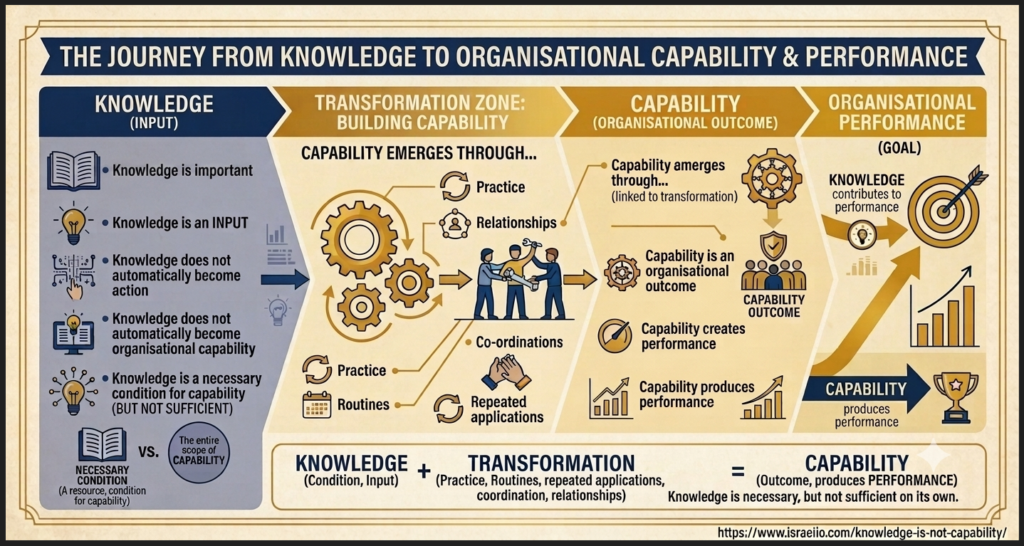
The common thread running through these examples is that knowledge remains potential until it becomes embedded in action. Organisations can possess information, expertise, and even broad agreement about what should be done without developing the ability to do it reliably. The difference between the two is capability.
What Organisational Capability Actually Means
If knowledge is not capability, then what is capability? At its simplest, capability is the organisational ability to apply knowledge effectively and repeatedly in pursuit of desired outcomes. It is visible not when an organisation succeeds once, but when it succeeds consistently, across different situations, under varying conditions, and over time.
Unlike knowledge, capability is inherently practical. An organisation may know how to respond to a crisis. Capability exists when it can actually do so under real conditions, with the right people, systems, and judgement in place. An organisation may understand what customers expect. Capability exists when that understanding is reliably translated into service and outcomes that match those expectations.
Knowledge contributes to capability, but capability reflects the successful integration of knowledge into organisational action. It is what happens when knowing and doing are no longer separate activities.
Capability Lives in Systems, Not Individuals Alone
One reason organisations struggle to build capability is that they assume it resides primarily in individuals. Individuals certainly matter, and expertise, experience, and judgement are all important. But organisational capability extends beyond any single person.
Capabilities survive and grow because they become embedded in routines, relationships, practices, and shared understandings. They are reinforced through repeated application and supported by systems that allow knowledge to move beyond individual expertise and become part of how the organisation operates as a whole. This is why some teams continue to perform well even as their membership changes, and why others fall apart when a key person leaves.
The distinction between individual knowledge and embedded capability becomes particularly visible when experienced employees retire, resign, or move on. If critical knowledge exists only within a small group of individuals, capability becomes fragile. When those individuals leave, performance deteriorates, sometimes dramatically. Where capability is truly established, however, knowledge has already been distributed, reinforced, and incorporated into the organisation’s routines and practices. The departure of a single individual creates challenges, but it does not undermine the organisation’s ability to function.
This points to something important: capability depends not only on what people know, but on how effectively organisations embed, share, and sustain that knowledge over time.
The Role of Organisational Memory
Closely connected to this is the idea of organisational memory, the accumulated store of knowledge, experience, and understanding that an organisation carries forward from one period to the next. Organisational memory includes not just what is written down in documents and databases, but the informal knowledge held in relationships, routines, and the shared experience of working through problems together.
When organisational memory is healthy, new employees can draw on the lessons of those who came before them, teams do not have to rediscover solutions to problems that were already solved, and the organisation is able to build on its own experience rather than starting from scratch with each new challenge. When organisational memory is weak or fragmented, the same mistakes tend to recur, institutional knowledge disappears with departing staff, and the organisation finds itself repeatedly relearning what it should already know.
The connection to capability is direct. An organisation with strong organisational memory is better placed to convert knowledge into capability, because the pathways through which knowledge becomes embedded in practice are better developed and better maintained. An organisation with weak organisational memory tends to accumulate knowledge without ever quite turning it into reliable, sustained capability, because the mechanisms for embedding and preserving that knowledge are missing or poorly maintained.
This is one reason why capability is not simply a function of how much an organisation knows, but of how well it remembers, and how effectively it uses what it remembers. Organisational memory is not simply about preservation, however. It is also about renewal. Knowledge that is remembered but never updated can become just as problematic as knowledge that is forgotten.
Beyond Knowledge
Recognising that knowledge is not capability changes the questions worth asking. Rather than focusing only on how much knowledge an organisation possesses, the more revealing questions tend to be: how effectively does the organisation use what it knows? How consistently can it apply knowledge across different situations and conditions? What allows some forms of knowledge to become embedded in practice while others remain unused or quickly forgotten?
These questions shift attention away from knowledge as an asset to be accumulated and towards capability as an organisational achievement to be built and sustained deliberately. They also point toward a deeper challenge. If capability does not emerge automatically from knowledge, then how exactly is it built? What conditions allow knowledge to move from individual understanding into the routines, systems, and practices through which organisations actually perform?
That question is worth examining more closely, and it is where the next article in this series picks up.
Looking Ahead
Knowledge remains one of the most valuable resources available to any organisation. Without knowledge there can be no learning, no improvement, and no meaningful adaptation.
But knowledge alone is not enough. Organisations do not succeed simply because they know more. They succeed because they develop the ability to translate knowledge into coordinated action, sustained performance, and continued adaptation over time.
The distinction may appear subtle, but its implications run deep. Many organisational challenges that look like knowledge problems are, in reality, capability problems. And addressing capability problems requires a different kind of thinking, one that looks beyond what organisations know and asks instead how effectively they are able to use, embed, and renew what they know.
That question sits at the heart of this research programme. Understanding how knowledge becomes capability is not simply an academic concern. It is central to how organisations learn, adapt, perform, and remain viable over time. The next article explores how that transformation takes place.